
A Pneumatic Conveyor can move flour, cement, plastic pellets, or grain through enclosed pipes, keeping material off open belts and floors. Yet choosing a supplier is not simply a matter of comparing catalogue capacity. Product fragility, dust control, conveying distance, and maintenance access all change the design. A line that handles dry pellets well may damage delicate flakes. Small details matter.
Grand View Research’s Pneumatic Conveying System Market report estimated the global market at about US$6.1 billion in 2023. That figure signals substantial demand, but it does not tell buyers which supplier fits a particular plant. David Mills, author of Pneumatic Conveying Design Guide, describes the principle this way: “Pneumatic conveying is the transport of bulk materials through a pipeline by means of a gas, usually air.” The engineering challenge lies in applying that principle to real materials and operating conditions.
This guide compares ten suppliers for global buyers, focusing on system expertise, product range, project support, and service reach. A useful shortlist should also prompt practical questions: Can the supplier test your material? Are spare parts available near your site? How are bends, filters, and air consumption handled? These points are easy to overlook. Supplier claims deserve verification against references and project-specific data; no ranking can replace a material trial or a careful review of operating costs.
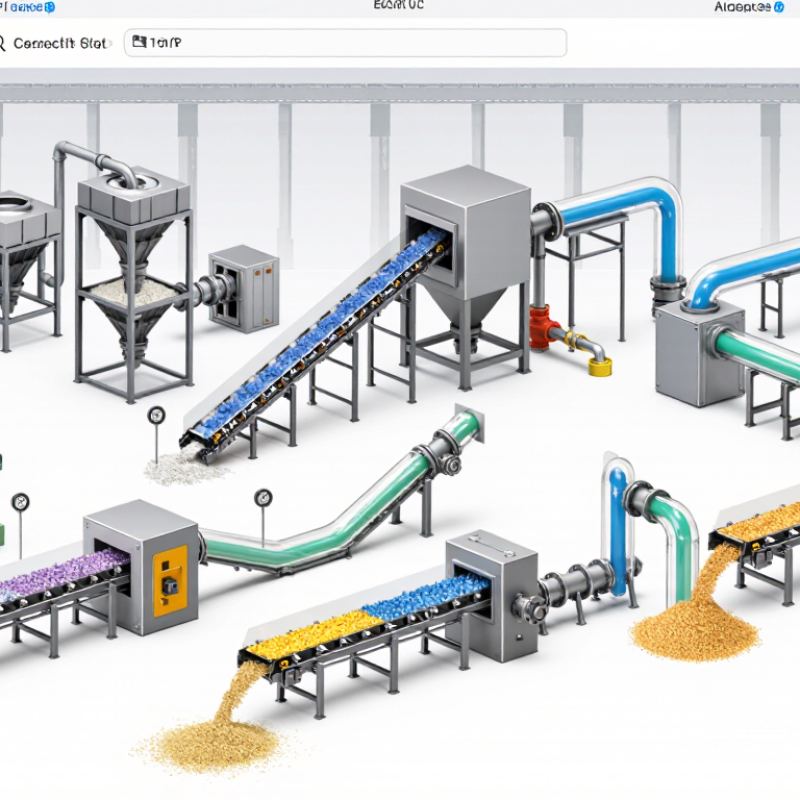
Pneumatic conveying moves powders and granules through enclosed pipes using air or another gas. A blower creates the airflow; feed points, bends, filters, and receivers shape the route. It can carry flour, plastic pellets, cement, or fine mineral powders between silos and process equipment. The European Commission’s 2019 Best Available Techniques Reference Document for the Food, Drink and Milk Industries discusses dry-material handling in production settings. That context matters: a system must protect product quality, not simply move material.
Two common approaches are dilute-phase and dense-phase conveying. Dilute phase suspends particles in faster-moving air, while dense phase pushes larger batches at lower speeds. The right choice depends on distance, throughput, particle fragility, and dust control. Small details matter. A tight bend can increase wear, and a poorly sized filter can interrupt production. The U.S. Department of Energy’s Improving Compressed Air System Performance guide reports that compressed air uses about 10% of industrial electricity, with some facilities reaching 30%. That figure covers compressed air broadly, not conveying alone, but it highlights why leaks and pressure settings deserve attention. Pneumatic systems suit food processing, chemicals, plastics, and minerals, though they are not automatically the most efficient option. Real plants are rarely perfect. A short pilot test can expose problems that a neat drawing misses.

Evaluating pneumatic conveyor suppliers for a global project begins with the material, not the catalogue. Ask for conveying tests using a representative sample, including its moisture, particle size, and bulk density. A powder that flows well in a clean lab may bridge in a long, humid line. Small details matter.
Check whether the supplier can explain system choices in plain terms. Dense-phase and dilute-phase systems place different demands on air pressure, pipe bends, and product handling. Request a process diagram, expected throughput, air consumption, and pressure-drop assumptions. Compare these figures with your operating schedule and utility capacity. If key assumptions are missing, pause.
Global projects also depend on execution after the proposal. Confirm who handles layout review, controls integration, commissioning, operator training, and spare-parts planning. Ask for references involving similar materials and conveying distances, not merely similar industries. Review wear points, inspection access, and cleaning steps; a hard-to-reach elbow can become a recurring maintenance problem. Site conditions vary, and a neat quotation cannot capture every one. Challenge optimistic performance claims and consider a pilot or acceptance test. It takes longer. It may prevent an expensive mismatch. Check response times across time zones, documentation language, and support for local technicians. A capable supplier should welcome specific questions, including uncomfortable ones.
Global buyers will find that pneumatic conveyor suppliers differ more in application knowledge than in brochure claims. A European systems integrator may design dense-phase lines for long routes and tight plant layouts. A North American equipment maker may focus on dependable dilute-phase transfer and readily available service parts. An Asian manufacturer may offer compact package systems for projects with limited floor space. These are useful starting points, not guarantees.
A bulk-solids specialist can assess particle size, moisture, and conveying distance before recommending a line. A food-grade supplier should explain how contact surfaces are cleaned and inspected. A hygienic-process provider may support controlled handling, but buyers should verify documentation for each project. A mining-focused supplier may specify abrasion-resistant bends for rough materials. A cement-sector provider may prioritize dust control and robust filters. A modular-system supplier can simplify later expansion, while a retrofit specialist may adapt existing pipework and controls. Ask for references involving similar materials, operating hours, and route lengths. Then check what the quote excludes. It is easy to overlook commissioning, spare parts, or operator training. Real performance depends on the whole system, and a neat proposal can still leave unanswered questions.
Note: The entries below are anonymous, illustrative supplier capability profiles—not named companies or a verified ranking. System suitability depends on the material, process, layout, and operating conditions; buyers should confirm specifications directly with prospective suppliers.
| Profile | Typical Supplier Focus | Common Conveying Options | Typical Material Applications | Key Buyer Checks |
|---|---|---|---|---|
| Profile 1 | General-purpose dry bulk handling | Dilute-phase pressure or vacuum conveying | Free-flowing powders and granules, subject to material testing | Material throughput, conveying distance, pickup points, and destination count |
| Profile 2 | Low-velocity and dense-phase conveying | Dense-phase pressure systems, with operating mode selected for the material | Materials for which limiting particle damage, segregation, or pipeline wear is important | Material flow properties, line pressure, pipeline design, and conveying trials |
| Profile 3 | Vacuum conveying for enclosed transfer | Vacuum pickup and transfer to a receiver or process vessel | Dry ingredients transferred from bags, bins, or nearby process equipment | Receiver filtration, dust containment, pickup arrangement, and cleaning access |
| Profile 4 | Pressure conveying for centralized distribution | Pressure transfer from a feed point to one or more destinations | Bulk solids moved between storage, processing, and packaging areas | Destination routing, pressure requirements, feed equipment, and line isolation |
| Profile 5 | Food and ingredient handling | Vacuum or pressure systems with application-specific hygienic design | Dry food ingredients and other process materials compatible with the proposed system | Contact-material requirements, cleanability, allergen controls, and applicable regulations |
| Profile 6 | Pharmaceutical and high-containment transfer | Enclosed vacuum or pressure conveying with containment features as required | Powders requiring controlled handling in regulated production environments | Containment targets, cleaning validation needs, documentation, and changeover procedures |
| Profile 7 | Abrasive-material conveying | Pressure or dense-phase systems designed around wear and material behavior | Abrasive bulk solids, depending on particle size, hardness, and system design | Wear-resistant components, bend design, maintenance access, and expected service life |
| Profile 8 | Combustible-dust process applications | Enclosed conveying systems with risk controls specified for the installation | Combustible powders or dust-producing materials after a suitable hazard assessment | Dust hazard analysis, explosion protection, grounding, isolation, and local code compliance |
| Profile 9 | Multi-line and multi-destination plant systems | Configured pressure or vacuum networks with diverters and control logic | Materials routed between multiple storage, production, or packaging locations | Routing matrix, product changeovers, controls integration, and prevention of cross-contamination |
| Profile 10 | Engineered systems and plant integration | Application-specific pneumatic conveying packages integrated with upstream and downstream equipment | Bulk materials requiring coordinated feeding, conveying, separation, or process control | Scope boundaries, interface drawings, commissioning support, spare parts, and service coverage |
When comparing pneumatic conveyor suppliers, look beyond advertised capacity. Dilute-phase systems move powders quickly through pipes, while dense-phase designs can reduce particle damage and dust. Ask how each supplier handles your material’s moisture, abrasiveness, and bulk density. A sample test with your actual powder is more useful than a generic throughput chart.
Service matters as much as technology. Check whether suppliers provide system sizing, commissioning, operator training, spare parts, and troubleshooting support. The U.S. Department of Energy’s Improving Compressed Air System Performance sourcebook reports that compressed air uses about 10% of electricity in U.S. industry. Conveyor efficiency therefore deserves scrutiny: request estimated air consumption and operating costs, not just equipment prices. A tidy performance curve is not a plant trial; I would still verify it under real feed conditions.
Tips: Bring a material sample and a list of peak and average production rates to supplier discussions. Ask for references from similar industries, such as food processing, chemicals, or minerals. Check filter access and cleanout points in the layout. Small maintenance details matter.
Selecting a pneumatic conveyor begins with the material, not the catalogue. Record particle size, bulk density, moisture, temperature, and whether the product breaks easily. A fine powder may need different airflow and filtration from abrasive granules. Small details matter. Map the route, including bends, vertical lifts, and discharge points. These affect pressure, capacity, and wear. Ask suppliers to explain whether dilute-phase or dense-phase conveying better fits the duty, and request test data for comparable materials. In practice, the first specification is often incomplete. That is normal, but gaps should be resolved before comparing quotations.
For global sourcing, compare the full system scope, not just the equipment price. Confirm who supplies piping, controls, filters, commissioning, and operator training. Ask for drawings, utility requirements, recommended spares, and realistic service response times across your region. Dust matters. Check how the supplier validates throughput and product condition during a factory or site acceptance test. Clarify delivery terms, packaging, installation support, and responsibility for interfaces with existing equipment. Energy use and filter maintenance can change operating costs over time. A low initial quote may still leave important assumptions unstated, so request them in writing and review them with the plant team.
Compare conveying modes as an early screening step when evaluating system proposals from suppliers.
Indicative ranges in metres per second: dilute phase, 15–30 m/s; dense phase, 3–10 m/s. Actual operating velocities depend on the material, pipeline layout, and system design. Confirm the appropriate range with a qualified supplier.
Please fill out this form and we will get an order or estimate ready for you. Please give us as much detail as you can for us to get started, and we will contact you to finsh the work order.