
Choosing Silicone Decorative Molds involves more than comparing floral patterns, cavity counts, or catalog prices. Small defects matter. A trapped bubble can spoil a plaster rose, while poor tear resistance can damage delicate borders during demolding. Buyers need consistent performance. This guide to China’s top 10 manufacturers focuses on practical sourcing questions, including material specifications, sample quality, and production repeatability.
China’s manufacturing scale provides useful context. PlasticsEurope’s Plastics – the Fast Facts 2023 reports that global plastics production reached 400.3 million tonnes in 2022. China accounted for 32% of that output. These figures describe the broader plastics industry; they do not measure the silicone decorative mold market specifically. Scale alone proves little. For decorative applications, buyers should examine silicone hardness, dimensional stability, curing requirements, and compatibility with their intended casting materials. A mold that releases wax cleanly may behave differently with resin, concrete, or gypsum.
The manufacturers considered here should therefore be assessed against clear, application-specific criteria. Ask for close-up sample photographs showing fine lettering, thin edges, and recessed details. Request hardness measurements using an identified method, such as ASTM D2240, alongside realistic lead times and replacement terms. Documentation deserves scrutiny too. Any food-contact claim needs supporting evidence appropriate to the intended use and destination market. Price remains important, and a cheap sample can look surprisingly convincing. That impression may be misleading. Without repeated casting trials, even an attractive shortlist remains provisional, especially when buyers need reliable detail across larger production runs.
Top 10 Silicone Decorative Molds Manufacturers in China
Silicone decorative molds come in many forms, including flexible cavity molds, textured sheets, and multi-part designs. They are used for cake decorations, candles, soap, resin crafts, and plaster ornaments. However, one mold does not suit every material. Check its temperature range and intended use before production.
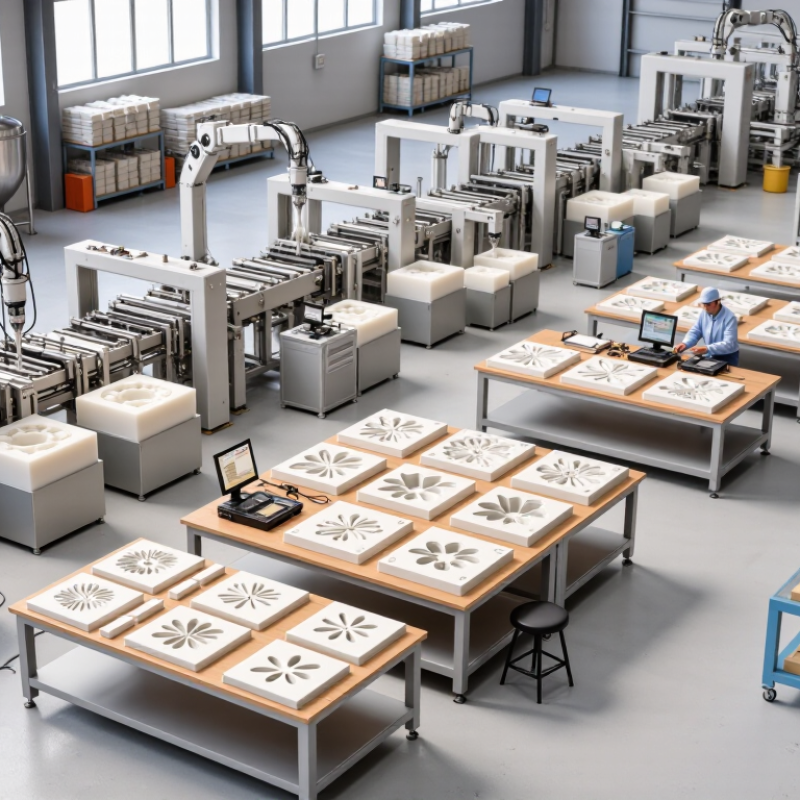
Manufacturing often begins with a CAD design and a carefully finished master pattern. Silicone is poured around the pattern, then degassed to reduce trapped air. After curing, workers demold and inspect the cavities for tears, uneven edges, and fine surface details. Small defects matter. In practice, complex designs can look impressive but may release poorly or require more hand finishing. A sample run helps reveal these issues before a larger order.
Tips: Ask for a material specification and a sample mold. Test it with your actual casting material, not just water. Check whether thin details fill cleanly and whether the finished piece releases without stretching. Small tests can prevent costly surprises.

Silicone Decorative Mold Types, Applications, and Production Methods
The chart compares typical curing or mold temperatures for common silicone production methods. Room-temperature vulcanizing (RTV) silicone cures at ambient temperature, while heat-cured silicone and liquid silicone rubber (LSR) are generally processed with heated molds. Actual temperatures vary by material formulation and production schedule.
For decorative molds, Shore A 10, 20, and 30 describe increasing resistance to indentation, not three complete material recipes. ASTM D2240 and ISO 48-4 specify durometer test methods; readings depend on specimen thickness, temperature, and test timing. Compare samples under the same conditions. A number without a test method is weak evidence.
Shore A 10 feels very soft and can help capture fine details, but thin mold walls may deform during filling. Shore A 20 offers more support while remaining flexible for releasing textured pieces. Shore A 30 resists handling pressure better, though tight undercuts may need more careful demolding. These are practical tendencies, not guarantees. Tear strength and elongation matter too.
Market context helps explain the demand for reliable silicone data, but it cannot select a mold grade. Grand View Research estimated the global silicone market at USD 20.8 billion in 2023 and projected 6.2% annual growth from 2024 to 2030. That broad market figure does not measure decorative molds specifically. Ask suppliers for hardness test conditions, cure details, and sample pieces. Then test a real design. Small differences can surprise.
Material-selection reference only—not a verified manufacturer ranking or a specification for any particular supplier. Silicone properties vary by formulation and test conditions; confirm product data with the supplier before production.
| Material data dimension | Shore A 10 | Shore A 20 | Shore A 30 |
|---|---|---|---|
| Nominal hardness | 10 Shore A | 20 Shore A | 30 Shore A |
| Relative indentation resistance | Lowest of the three grades; readily indented | Intermediate; balances softness and support | Highest of the three grades; more resistant to indentation |
| Flexibility during demolding | Very flexible; can help release shapes with undercuts, but may stretch more | Flexible; often a practical middle ground for decorative shapes | Less pliable than softer grades; may need a more open mold design for complex undercuts |
| Resistance to shape distortion | More prone to bending or distortion under handling or load | Moderate support; suitability depends on mold size and wall thickness | Generally offers more shape support than the softer grades |
| Potential mold-use fit | Consider for flexible molds with deep relief or pronounced undercuts | Consider for general-purpose decorative molds where both flexibility and support matter | Consider for flatter or more supported mold designs that benefit from greater firmness |
| Fine-detail suitability | Can reproduce fine surface features when the formulation and mold-making process are suitable | Can reproduce fine surface features; hardness alone does not determine detail quality | Can reproduce fine surface features; confirm performance with a sample mold |
| Tear strength | Cannot be determined from Shore A hardness alone; request tear-strength data | Cannot be determined from Shore A hardness alone; request tear-strength data | Cannot be determined from Shore A hardness alone; request tear-strength data |
| Hardness measurement | Specify Shore A test method, specimen thickness, and conditioning when comparing results | Specify Shore A test method, specimen thickness, and conditioning when comparing results | Specify Shore A test method, specimen thickness, and conditioning when comparing results |
| Relevant test standard | Shore hardness is commonly measured using ASTM D2240 or ISO 48-4; verify the method used | Shore hardness is commonly measured using ASTM D2240 or ISO 48-4; verify the method used | Shore hardness is commonly measured using ASTM D2240 or ISO 48-4; verify the method used |
| Supplier data to request | Technical data sheet, hardness tolerance, tear strength, cure conditions, and sample evaluation | Technical data sheet, hardness tolerance, tear strength, cure conditions, and sample evaluation | Technical data sheet, hardness tolerance, tear strength, cure conditions, and sample evaluation |
For decorative silicone molds, ISO 9001:2015 is a useful starting point, not a quality guarantee. Ask each manufacturer for a current certificate and confirm its scope covers mold design or production. Check the certificate dates and issuing body. Request sample records for silicone inspection, batch identification, dimensional checks, and corrective actions. Small details matter: a shallow cavity can leave a casting visibly uneven. Ask for the certificate.
Production capacity needs context. A monthly output figure means little without mold size, design complexity, and customization requirements. Ask how many molding machines are available, how shifts are scheduled, and how much capacity is already committed. Request a recent production plan with confidential details removed. Numbers can shift. Some factories count finished pieces; others count mold sets, so their figures may not be directly comparable.
Before placing a large order, request a pilot run using the intended design and silicone grade. Inspect cavity depth, surface finish, flexibility, and consistency across several pieces. Compare the results with the manufacturer’s stated inspection process. A factory may have strong paperwork but limited room for urgent orders; another may have spare machine time but uneven documentation. That trade-off deserves a closer look.
A useful comparison of China’s top 10 silicone decorative mold manufacturers starts with the mold itself, not the sales pitch. Check cavity depth, edge definition, and whether fine textures survive repeated demolding. Ask for a sample made with the same silicone grade and process as the production run. Details matter. A glossy sample can hide uneven walls or small air pockets.
Compare each supplier’s material options, custom-tooling capability, quality checks, and quoted lead time. Grand View Research estimated the global silicone market at USD 18.5 billion in 2023, with projected annual growth of 6.4% from 2024 to 2030. This broad market figure is useful context, not a measure of decorative mold sales. It does signal why material consistency and manufacturing capacity deserve attention. Not always. More capacity alone does not mean better cavity accuracy.
For a fair comparison, request dimensional tolerances, production photos, and details of how defects are handled. Test a mold with your actual material, temperature, and release method; a small flower pattern may expose sticking that a simple shape will not. Compare landed cost, too, including packaging and replacement samples. One awkward point: supplier catalogs rarely show long-term wear clearly. Ask how many cycles their performance claims represent, then judge the answer against your own use.
Compare suppliers using the same drawing, silicone grade, cavity count, and sample design. Grand View Research valued the global silicone market at USD 18.5 billion in 2023 and projected a 6.7% annual growth rate through 2030. This is useful market context, not proof of mold durability. Ask for mold-life estimates under your actual temperature, release method, and production cycle. “Thousands of uses” means little without test conditions. Ask for evidence.
Separate tooling charges from unit cost. Confirm whether trimming, inspection, packaging, and sample revisions are included. Record MOQ for both samples and repeat orders; a low unit price may depend on a large batch. Check lead time in calendar days, split into toolmaking, sample approval, and production. Request dated milestones and a written definition of when the clock starts. Inspect a sample for thin edges, trapped bubbles, and clean release. Also ask for dimensional checks and batch records. A supplier’s estimate is not a guarantee. Leave room for one imperfect sample round; it can expose design issues before a larger order.
Please fill out this form and we will get an order or estimate ready for you. Please give us as much detail as you can for us to get started, and we will contact you to finsh the work order.