What is a Negative Thermistor and Its Benefits for Buyers?
Negative Thermistors are vital components in the electronics and automotive industries. These devices respond to temperature changes by altering their resistance. Buyers often seek negative thermistors for various applications, from temperature sensing to circuit protection. Their unique property of decreasing resistance with rising temperature makes them valuable.
Understanding how negative thermistors function is essential for optimal usage. They can help enhance the performance of electronic systems by improving temperature stability. Buyers must consider key factors when selecting these components, such as sensitivity and response time. Sometimes, the choices can be overwhelming.
Additionally, sourcing high-quality negative thermistors can be challenging. It’s crucial to evaluate manufacturers for reliability and expertise. Taking time to research can yield long-term benefits. While negative thermistors offer significant advantages, potential buyers should be aware of the challenges they may face. Ignoring these aspects can lead to dissatisfaction.
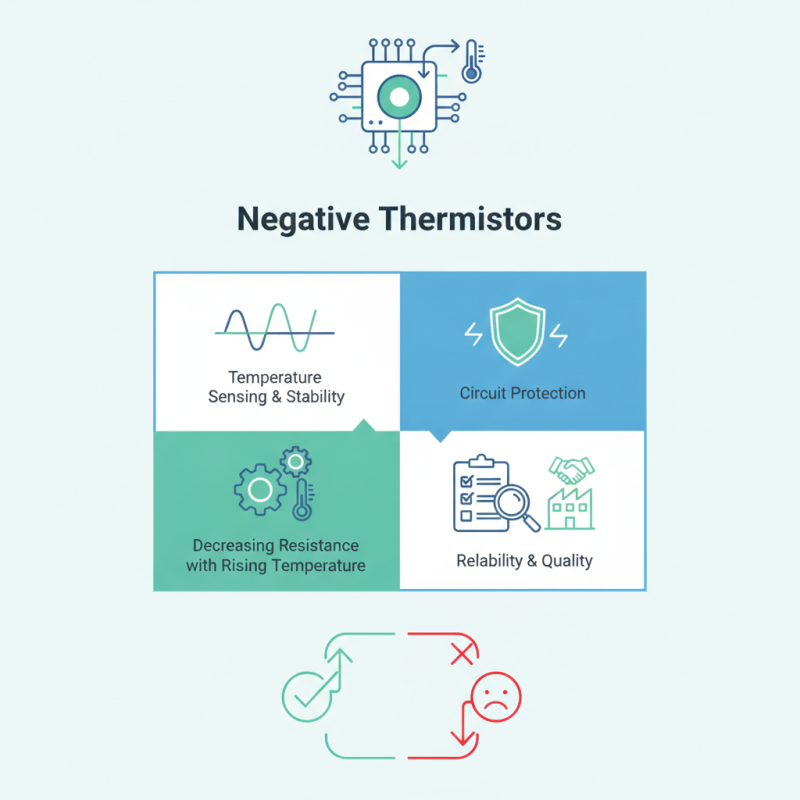
Definition and Function of a Negative Thermistor
A negative thermistor is a type of resistor whose resistance decreases as temperature increases. This unique characteristic makes it ideal for various applications, particularly in temperature sensing. Negative thermistors are commonly used in electronic devices, automotive systems, and industrial processes. Their sensitivity to temperature changes allows for precise monitoring.
The primary function of a negative thermistor is to provide accurate temperature measurements. They adapt quickly to changes, ensuring timely data for controlling environmental conditions. By integrating a negative thermistor, designers can improve energy efficiency in their products. For example, in HVAC systems, they can optimize heating and cooling cycles based on real-time temperature readings. This leads to significant energy savings.
Despite their numerous benefits, negative thermistors have limitations. Their nonlinear response to temperature can complicate circuit designs. Calibration may be necessary to ensure accurate readings. Additionally, they can be sensitive to moisture, which could affect performance. Understanding these factors is essential for effective implementation.
Types of Negative Thermistors and Their Applications
Negative thermistors (NTCs) are specialized temperature sensors. They have unique characteristics that make them valuable in various applications. Understanding the types of NTCs can help buyers make informed decisions.
One common type of negative thermistor is the bead thermistor. This design offers rapid response times. It’s ideal for applications requiring precise temperature measurements, such as in HVAC systems or medical devices. Another type is the disk thermistor, which provides stability in temperature measurement. You will often find them in consumer electronics, ensuring devices operate within safe temperature ranges.
NTCs also play a crucial role in automotive and industrial settings. Their use helps in monitoring engine temperatures. However, improper placement can lead to inaccurate readings. Buyers should consider these factors when selecting a thermistor. It’s essential to understand the operating environment to ensure reliability and accuracy in applications.
What is a Negative Thermistor and Its Benefits for Buyers? - Types of Negative Thermistors and Their Applications
| Type of Negative Thermistor | Temperature Range (°C) | Resistance at 25°C (Ohms) | Common Applications | Benefits |
| NTC Thermistor | -55 to 125 | 10k | Temperature sensing in HVAC | High sensitivity and accuracy |
| NTC Type B | 0 to 100 | 5k | Battery monitoring | Compact and easy to integrate |
| NTC Ceramic Thermistor | -40 to 150 | 100k | Household appliances | Durable and long-lasting |
| NTC Film Thermistor | -40 to 100 | 2.2k | Medical devices | Fast response time |
| NTC Glass Thermistor | -50 to 300 | 50k | Industrial applications | Excellent stability |
Advantages of Using Negative Thermistors in Electronics
Negative thermistors are vital components in electronic devices. They help regulate temperature by decreasing resistance as temperature rises. This unique characteristic allows for accurate temperature monitoring, making them ideal for temperature sensors and circuit protection.
One major advantage is their sensitivity. Negative thermistors can detect even slight temperature changes. This sensitivity improves the efficiency of devices such as heaters and coolers. In many applications, their fast response time is crucial. However, buyers should consider their limitations. They can be less accurate at extreme temperatures. This can lead to challenges in specific environments.
Another benefit is cost-effectiveness. Negative thermistors are generally less expensive than other temperature sensors. Their simplicity is appealing to manufacturers. However, design engineers must ensure proper circuit integration. Miscalculating resistance values can lead to errors. These factors add an extra layer of complexity when implementing them in new designs.
Factors to Consider When Purchasing Negative Thermistors
When considering a negative thermistor, buyers should pay attention to several key factors that impact their performance and reliability. The temperature range is crucial. A thermistor that operates outside its specified range may give inaccurate readings or fail altogether. Assess the application requirements. Some devices may need high sensitivity, while others may not benefit from it.
**Tips:** Check the temperature coefficient. A higher negative temperature coefficient indicates a stronger response to temperature changes. This can improve the accuracy of your device.
The resistance values matter too. Buyers need to understand both the nominal resistance and how it changes with temperature. Inaccurate resistance could lead to system errors. Look for thermistors with stable readings for optimal performance.
**Tips:** Ensure you evaluate the thermal time constant. This indicates how quickly the thermistor responds to temperature changes. A fast response is essential in many applications.
Finally, consider the physical characteristics of the thermistor. The size and form factor can affect installation and compatibility. Ensure it fits within your design constraints for a hassle-free integration. Also, remember to verify the manufacturer’s data sheets for all specifications. It’s essential for comprehensive understanding.
Common Industries Utilizing Negative Thermistors for Efficiency
Negative thermistors are widely used across various industries for their efficiency in temperature sensing and control. These devices are particularly effective in applications where precision is crucial. For example, in the automotive sector, they help monitor engine temperature, ensuring optimal performance and preventing overheating. Accurate temperature readings can improve safety and enhance the longevity of vehicles.
In the field of HVAC, negative thermistors regulate air conditioning systems. They adjust cooling based on ambient temperature, leading to energy savings and increased comfort. Healthcare also benefits significantly. Medical devices often incorporate these thermistors for patient monitoring. Accurate readings can be critical in detecting fevers or other health issues. The ability to provide reliable data is vital in these high-stakes environments.
Despite their benefits, there can be limitations. Negative thermistors may not perform well in extreme temperatures. Also, they can be sensitive to rapid changes in temperature, leading to delayed responses. Understanding these factors is important for industries relying on this technology. Buyers should consider whether the advantages outweigh potential drawbacks for their specific applications.
Negative Thermistors and Their Benefits Across Industries
This bar chart illustrates the various industries that utilize negative thermistors and the efficiency improvements achieved in each sector.

