
Buying 18650 batteries in bulk requires more than comparing prices on a supplier’s website. These compact cells may look identical, yet their capacity, chemistry, discharge rating, and production history can differ sharply. A reliable purchase begins with a clear application. Will the cells power flashlights, backup equipment, testing devices, or battery packs? Each use demands careful matching.
This guide shares ten practical tips for evaluating bulk suppliers, specifications, samples, and delivery conditions. Check the manufacturer, model number, nominal voltage, capacity, and maximum continuous discharge rating. Request recent test data, batch information, and clear photographs of the labels. A trustworthy supplier should answer specific questions without avoiding technical details. Samples matter. Test them before placing a large order.
I have seen buyers focus too heavily on low unit prices. That decision often creates hidden costs later. Weak cells can increase sorting time, reduce runtime, or damage an entire project. Storage also deserves attention. Keep batteries cool, dry, protected from short circuits, and separated from loose metal objects. Confirm the supplier’s packaging and transport procedures.
Do not trust impressive claims alone. Verify them.
Even experienced purchasers can overlook small differences between similar models. I have made that mistake myself. A careful checklist helps prevent rushed decisions, but it cannot replace independent testing. The goal is not simply to buy more cells. It is to obtain consistent, traceable, and suitable batteries from a responsible source.
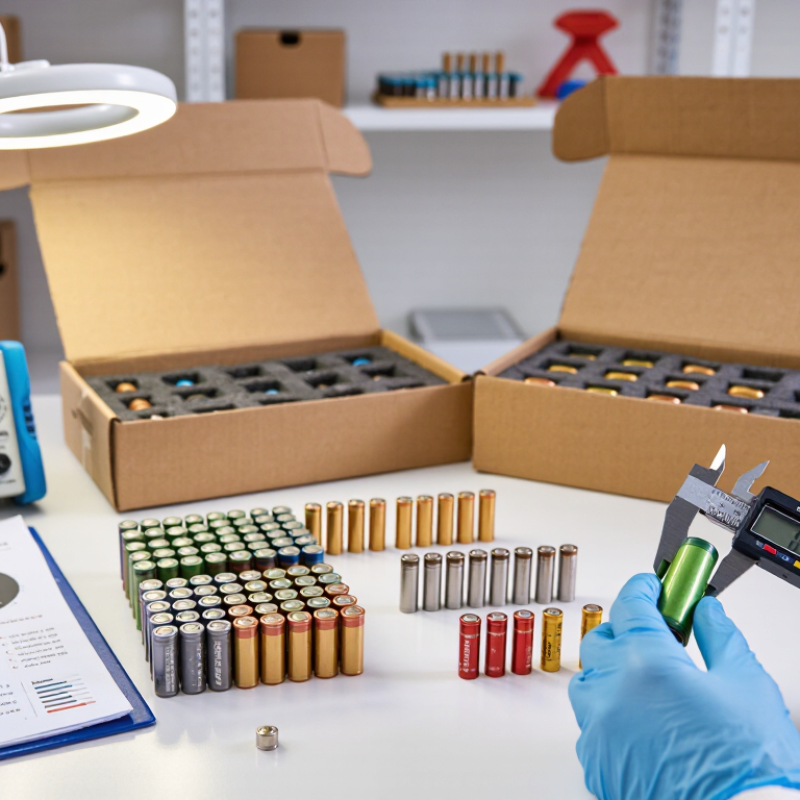
Before buying 18650 batteries in bulk, define the job each cell must perform. A flashlight, testing device, and power tool need different discharge profiles. Record nominal voltage, capacity, continuous discharge current, pulse current, operating temperature, and expected cycle life. Also confirm the required diameter and length. A few millimeters can stop a cell from fitting.
Use testable requirements, not marketplace labels. IEC 61960-3 provides methods for measuring lithium-cell capacity, discharge performance, and cycle durability. Ask suppliers for recent test reports, batch numbers, internal resistance readings, and storage conditions. The 2024 BloombergNEF Battery Price Survey reported an average lithium-ion pack price of 115 dollars per kilowatt-hour. That figure does not predict individual 18650 pricing, but it shows why unusually cheap offers deserve careful checking. The IEA reported global battery demand exceeding 750 gigawatt-hours in 2023, increasing pressure on materials and quality control.
I once treated “high capacity” as enough information. It was not. A cell rated for capacity may fail under sustained current. Decide whether you need protected cells, matched cells, or loose cells for an approved battery-management system. Specify minimum measured capacity, maximum resistance, acceptable voltage variation, and sampling rules before payment. Leave room for mistakes. Storage temperature, transport delays, and aging can reduce usable performance, even when the label looks perfect.

These representative planning targets show how intended applications influence the required capacity and continuous discharge current of an 18650 cell. At a nominal 3.6 V, a 3,000 mAh cell stores approximately 10.8 Wh before conversion losses. Always verify tested capacity, continuous discharge rating, temperature limits, protection requirements, and series-parallel configuration against the cell datasheet before placing a bulk order.
Buying 18650 batteries in bulk requires more than comparing prices. In receiving inspections, I check the cell format, nominal voltage, capacity, discharge rating, and chemistry. Tip 1: Request a complete specification sheet. Confirm every value against the physical cell and packaging. A printed label is not proof. Tip 2: Ask for production dates and batch numbers. Mixed batches can produce uneven performance.
Authenticity needs independent checks. Tip 3: Purchase a small sample before placing a large order. Measure capacity, internal resistance, voltage, and weight with calibrated equipment. A few cells may pass while the wider batch fails. I once trusted a neat-looking specification sheet too quickly. That mistake taught me to test samples under controlled conditions. Tip 4: Compare test results with the supplier’s claims, and record the differences. Be cautious when capacity seems unusually high for the stated size.
Tip 5: Request current safety certificates and the related laboratory reports. Verify the certificate number, issuing body, test standard, and product model. Certificates should match the exact cell, not merely a similar series. Tip 6: Check transport documentation and safety data sheets before shipment. Tip 7: Confirm whether the cells are protected or unprotected. Tip 8: Inspect insulation rings, terminals, and wrappers for damage. Tip 9: Store cells in dry, cool conditions, away from metal objects. Tip 10: Keep batch records and quarantine questionable cells. Certifications can expire. Documents can also be misunderstood, so independent verification remains worthwhile.
10 Tips for Buying 18650 Batteries in Bulk
Compare suppliers beyond the lowest quote. Ask for datasheets, recent test reports, production dates, and traceable lot numbers. Tip 1: Confirm cell chemistry and rated capacity. Tip 2: Check discharge ratings using independent test results. Tip 3: Request samples before placing a large order. A polished spreadsheet is not proof.
Pricing can change with quantity, packaging, shipping, and payment terms. Tip 4: Compare the complete landed cost, not only the unit price. Tip 5: Ask whether the minimum order quantity applies per model, capacity, or shipment. Tip 6: Negotiate staged deliveries if storage space is limited. Tip 7: Confirm acceptable tolerances for capacity and internal resistance. Small differences matter.
Warranty terms require careful reading. Tip 8: Check the warranty period and its starting date. Tip 9: Ask who pays inspection, return, and replacement costs. Tip 10: Require a clear process for defective cells, including evidence requirements and response times. I once overlooked a narrow claim window; that mistake made the purchase less secure. Suppliers with consistent records, transparent test methods, and responsive technical staff usually deserve greater confidence. Still, verify everything in writing.
10 Tips for Buying 18650 Batteries in Bulk
When buying 18650 batteries in bulk, inspect every lot before accepting delivery. Look for dents, torn wraps, corrosion, leakage, or unusual odors. A damaged cell should never enter your test batch. Measure voltage with a calibrated meter, then record each reading by lot. Large voltage differences may indicate long storage, imbalance, or hidden damage. Do not rely on appearance alone.
Ask for storage history, production dates, and transport conditions. Cells stored for years in heat may lose capacity before testing begins. Cool, dry storage is preferable, with terminals protected from contact. I once treated an old, clean-looking batch as low risk. That assumption was too optimistic. Sampling capacity from several cartons would have revealed wider variation. Test resistance and capacity using suitable equipment, following the cell’s technical limits. Stop testing if a cell becomes hot, swells, or behaves strangely.
Quality control should include traceable lot numbers, inspection records, and clear acceptance criteria. Test samples from the beginning, middle, and end of a shipment. A single successful sample proves very little. Compare measured capacity with the supplier’s specification, and separate cells by results instead of mixing everything together. Check the charger and tester calibration regularly. No inspection catches everything. Keep records of failures, even when the percentage seems small, because repeated defects often expose a weak storage or handling process.
| No. | Buying Dimension | What to Check | Practical Acceptance Criteria | Recommended Quality-Control Action | Risk Level |
|---|---|---|---|---|---|
| 1 | Cell Identity and Chemistry | Confirm that the cells are genuine 18650 lithium-ion cells and identify the chemistry, nominal voltage, and intended application. | Typical 18650 lithium-ion cells have a nominal voltage of approximately 3.6–3.7 V and a fully charged voltage of 4.2 V. Do not assume that every 18650 cell has the same capacity or discharge capability. | Request a technical datasheet, product specification, and batch identification. Keep cells with different chemistries or specifications in separate lots. | High |
| 2 | Physical Condition | Inspect the metal can, positive terminal, insulating ring, wrapper, and base for dents, corrosion, leakage, swelling, torn insulation, or burn marks. | Accept only cells with clean terminals, intact insulation, no visible deformation, and no evidence of liquid leakage or overheating. | Perform 100% visual inspection before charging. Quarantine damaged cells and prevent contact between loose cells and conductive objects. | High |
| 3 | Storage History | Ask how long the cells were stored, at what temperature, and at what approximate state of charge. | For long-term storage, a cool, dry environment and a partial state of charge are preferable. Avoid lots exposed to prolonged high temperature, direct sunlight, moisture, or fully charged storage. | Record the storage date, warehouse conditions, and measured open-circuit voltage for a representative sample from every shipment. | High |
| 4 | Open-Circuit Voltage | Measure the voltage after the cells have rested and before capacity testing. Large differences within one lot may indicate mixed stock or abnormal self-discharge. | Cells should be within the supplier's specified voltage range. Any cell with an unusually low voltage, unstable voltage, or visible damage should be isolated for further evaluation. | Use a calibrated digital multimeter and sample multiple cartons, layers, and pallet positions rather than checking only the top layer. | High |
| 5 | Capacity Verification | Compare measured discharge capacity with the rated capacity using a controlled test method. | Test the cells under the current, cutoff voltage, temperature, and rest periods specified by the applicable datasheet. A common laboratory approach uses a controlled discharge near 0.2C, but the supplier's method must be followed for valid comparison. | Test a statistically meaningful sample from each lot. Reject or segregate cells that fall below the agreed tolerance, rather than averaging away individual failures. | High |
| 6 | Internal Resistance | Measure internal resistance with the same instrument, temperature, state of charge, and waiting time for every sample. | Lower resistance generally supports better voltage stability and less heat under load, but values are instrument- and method-dependent. Compare results with the cell specification and lot baseline. | Establish an upper limit before purchase. Investigate cells with unusually high resistance or large variation from the lot median. | High |
| 7 | Self-Discharge Screening | Check whether cell voltage drops abnormally during a controlled rest period after charging or conditioning. | Cells in the same lot should show consistent voltage retention. A rapid or irregular voltage decline can indicate contamination, damage, aging, or internal leakage. | Use a documented rest interval and retest method. Separate abnormal cells and do not combine them with normal cells in a battery pack. | High |
| 8 | Batch Consistency | Review capacity, resistance, voltage, dimensions, and appearance across different production batches. | Cells intended for the same pack should have closely matched electrical characteristics. Mixing cells with different ages, capacities, or resistance can increase imbalance and reduce pack performance. | Use batch codes and receiving records. Require lot segregation and match cells within packs according to the pack designer's balancing requirements. | High |
| 9 | Packaging and Transport | Inspect packaging for terminal protection, short-circuit prevention, moisture protection, crushing, and signs of rough handling. | Cells should be individually protected or securely separated so that terminals cannot contact one another or conductive packaging. Packaging must comply with applicable lithium-battery transport rules. | Check shipping documents, carton labels, package condition, and quantity upon arrival. Photograph damage and quarantine affected cartons. | High |
| 10 | Supplier Quality Control | Evaluate traceability, inspection records, test equipment calibration, warranty terms, and the supplier's process for handling rejected cells. | A reliable bulk purchase should have a defined specification, lot number, inspection plan, acceptance limits, and documented corrective-action process. | Use a written purchase specification and incoming-inspection checklist. Approve the lot only after visual, electrical, and documentation checks are complete. | High |
Buying 18650 batteries in bulk requires a safety plan before the order leaves the supplier. Confirm chemistry, rated capacity, production date, and test records for every lot. Ask for current transport documentation and use packaging approved for lithium-ion cells. Protect terminals from contact, movement, and crushing during transit. Follow carrier rules and local requirements. Never assume one shipping method fits every quantity.
Store cells in a cool, dry, well-ventilated area away from direct sunlight. Keep them in nonconductive trays with clear lot labels. A partial charge is generally safer for long-term storage than full charge. Separate new, tested, returned, and questionable cells. Damaged, swollen, leaking, or unusually warm batteries need isolation and professional handling. Keep it boring. Temperature logs and routine visual checks can prevent small issues from becoming expensive ones.
Testing should include voltage, capacity, internal resistance, and physical condition. Use calibrated equipment, documented procedures, and trained staff. Test twice when readings look unusual. Sample every incoming lot, but increase testing when suppliers, dates, or results change. Record serial or batch information, inspection dates, storage location, and stock movement. Use first-in, first-out rotation and set minimum reorder levels. A common mistake is trusting inventory software without checking the shelves. Count physical stock regularly. No system catches every error. Refine the process when a mismatch, delayed shipment, or failed cell reveals a weakness.
Please fill out this form and we will get an order or estimate ready for you. Please give us as much detail as you can for us to get started, and we will contact you to finsh the work order.