
Global buyers need storage equipment that survives handling, stacking, and repeated shipment. A Collapsible Wire Mesh Container can reduce return freight and recover valuable floor space. Its hinged panels fold flat when empty. That simple feature matters in crowded warehouses. Yet, the best choice depends on load type, climate, and handling routines. No single model suits every operation.
This guide reviews ten leading options for export logistics, manufacturing, retail, and parts distribution. Each comparison considers working load, folded height, mesh opening, base design, access doors, and surface finish. It also examines pallet compatibility and forklift entry. These details affect safety and daily productivity. Galvanized steel may suit humid routes, while powder coating offers a cleaner appearance. Buyers should verify test data, tolerances, and replacement-part availability. Product pages can be incomplete. That deserves attention.
The selection process draws on practical warehouse experience and established material-handling principles. I look beyond attractive photos, because weld quality and hinge alignment appear after repeated cycles. A container may stack perfectly on paper but perform poorly on uneven floors. Ask suppliers for drawings, load ratings, inspection guidance, and packaging details. Confirm dimensions in millimeters and inches before ordering. Regional standards and customs requirements also need checking. Small errors become expensive quickly. This shortlist supports informed purchasing, but it cannot promise a universal winner. Read the trade-offs carefully, and test a sample when possible.
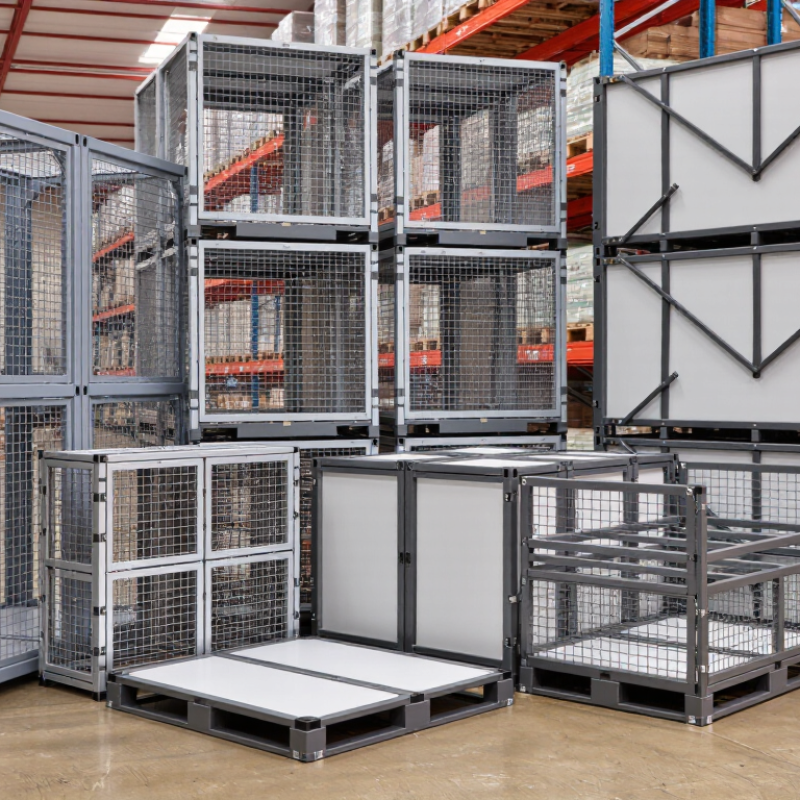
A collapsible wire mesh container is a reusable steel storage unit with mesh panels and a hinged frame. Its sides fold inward when the container is empty, reducing storage volume during return transport. Most models include a base, access gates, stacking feet, and forklift openings. The mesh permits airflow and visibility, which helps workers check contents without opening every unit. That simple movement saves space.
In warehouse operations, these containers hold components, packaged goods, tools, and recyclable materials. Their open structure supports quick visual checks and reduces moisture buildup around suitable products.
A typical buyer should examine wire diameter, mesh spacing, weld quality, floor strength, and the locking system. Load capacity must match both static stacking and moving conditions. A container may hold heavy parts safely on the floor but perform poorly when stacked.
Folded height matters during international shipping. Smaller return volume can lower freight costs, but only when folding hardware remains secure. I have seen specifications look impressive while access doors felt awkward during daily handling. That detail matters. Buyers should request unfolded and folded dimensions, surface-treatment information, test records, and clear instructions. Requirements differ by country, warehouse equipment, and industry. Local safety rules still need verification before purchase.

Collapsible wire mesh containers are designed for repeated handling, not simple storage. Welded steel wire forms a rigid cage while hinged panels fold inward when empty. This reduces return volume and warehouse space. The World Steel Association reported 1.89 billion tonnes of crude steel production in 2023. That scale supports broad material availability, but steel quality still varies between suppliers.
A practical container usually includes forklift entry points, stacking feet, locking gates, and a powder-coated or galvanized surface. Mesh openings improve visibility and airflow around cartons, components, or recycled materials.
Engineers must match wire diameter, panel strength, and rated load. ISO 21898 offers guidance for packaging performance, although it does not replace physical testing. In real warehouses, uneven floors and careless forklift impacts create problems.
No design is perfect. I would test a sample under vibration, stacking, and repeated folding before placing a large order.
Tips:
Confirm both static and dynamic load ratings. Measure the folded height before planning transport. Check hinge alignment after several cycles.
The International Energy Agency estimates that steel production creates roughly 7–9% of global energy-related emissions, so recycled content and long service life deserve attention. A container that lasts ten years may outperform a lighter unit replaced every year. That assumption should still be verified with maintenance records.
10 Best Collapsible Wire Mesh Containers for Global Buyers
Key Specifications for Comparing Global Container Options
Choosing among the 10 best collapsible wire mesh containers requires more than checking price. Start with external dimensions, internal capacity, and folded height. These figures affect truck loading, warehouse aisles, and return freight. Confirm the working load and stacking load separately. A container may hold 1,000 kilograms on the floor but support less when stacked.
Mesh opening size controls visibility, ventilation, and small-part security. Select wire diameter carefully, especially for castings, tools, or sharp-edged components. A hinged half-drop gate can improve access without unloading the entire container. Forklift entry should suit local equipment. Check whether feet, skids, or casters change the usable height. Small differences matter.
Surface treatment also deserves attention. Galvanized finishes may suit humid routes, while powder coating offers color identification and a smoother appearance. Ask for coating thickness, salt-spray results, and repair guidance. Folded units should lock securely and remain stable during handling. Request drawings, tolerance data, inspection records, and packaging details before purchasing. Measurements can vary slightly between production batches. That is easy to overlook. A perfect comparison is rarely possible because warehouse conditions, labor habits, and transport methods differ. Measure twice. Test one sample under real loading conditions before approving a large shipment.
Collapsible wire mesh containers support practical storage in busy warehouses. Their hinged panels fold flat when empty, reducing return-trip volume and saving floor space. Warehouses commonly use them for spare parts, fasteners, castings, and packaged components. A clear load label helps operators avoid uneven stacking. Fork pockets also improve handling with pallet trucks and forklifts. Mesh sides provide visibility during cycle counts and safety checks. Small openings matter when storing loose items.
Manufacturing plants use these containers near cutting, stamping, welding, and assembly areas. They separate work-in-process materials without hiding the contents. A steel base supports heavier loads, while removable gates can improve access beside production lines. Before purchase, teams should check working load, stacking height, weld quality, and surface protection. Not every container suits every process. Fine debris may pass through standard mesh, which creates extra cleaning work.
Logistics operations benefit from nestable returnable containers during internal transfers and supplier collections. Folded units occupy less trailer space, but careless folding can damage hinges or locking pins. Inspect them after impacts. Record repairs. That habit is often missed. Container dimensions should match pallet positions, dock equipment, and vehicle restraints. Operators also need training on balanced loading and secure closure. Trialing a small batch under real conditions can reveal problems that product drawings overlook. Temperature, moisture, and frequent outdoor handling may require a more durable finish.
10 Best Collapsible Wire Mesh Containers for Global Buyers
Selecting a collapsible wire mesh container starts with the cargo, not the price. UNCTAD reports that over 80% of global trade volume moves by sea, so containers face vibration, humidity, delays, and repeated handling. Measure the product, pallet, and loading equipment together. Leave space for safe access, but avoid excessive empty volume.
Check the working load, tare weight, stacking strength, folded height, and internal dimensions. A container that folds to one-third of its height can reduce return-trip space, but the saving depends on actual shipment volume. Confirm forklift-entry direction and door clearance. Small differences matter at a crowded loading dock. Wire spacing also deserves attention. Smaller openings protect loose parts, while wider mesh improves visibility and ventilation.
The World Bank’s 2023 Logistics Performance Index used feedback from 4,090 logistics professionals and assessed tracking, timeliness, customs, infrastructure, and service quality. These factors support a practical selection method: choose traceable markings, durable welds, corrosion protection, and clear load labels. Verify compatibility with pallets, warehouse racks, and carrier handling rules before purchase. International acceptance can vary by route and equipment. Ask for test records, dimensional drawings, and inspection procedures. Do not trust a catalog photograph alone. I have seen “universal” containers fit the warehouse but fail at the dock. That mistake is expensive.
| Rank | Container Type | Typical External Size (L × W × H) | Folded Height | Usable Volume | Approx. Tare Weight | Typical Safe Working Load | Mesh Opening | Surface Finish | Access Configuration | Stacking Guidance | International Shipping Suitability |
|---|---|---|---|---|---|---|---|---|---|---|---|
| 1 | Euro-Standard Collapsible Mesh Container | 1,200 × 800 × 970 mm | 245 mm | Approx. 0.72 m³ | 58 kg | 1,000 kg | 50 × 50 mm | Electro-galvanized steel | Half-drop gate on one long side | Up to 4 loaded units, subject to rack and load assessment | Best overall option for palletized export cargo and European distribution |
| 2 | Standard Export Wire Basket | 1,200 × 1,000 × 900 mm | 225 mm | Approx. 0.88 m³ | 64 kg | 1,200 kg | 50 × 50 mm | Powder-coated or galvanized steel | Two half-drop gates on opposite long sides | Up to 3 loaded units, depending on design and cargo stability | Suitable for mixed international freight and forklift handling |
| 3 | Heavy-Duty Collapsible Mesh Box | 1,200 × 1,000 × 1,000 mm | 250 mm | Approx. 0.96 m³ | 82 kg | 1,500 kg | 50 × 50 mm | Hot-dip galvanized steel | Full-width drop gate on one long side | Up to 4 loaded units when approved for vertical stacking | Recommended for dense metal parts, castings, and high-load industrial components |
| 4 | Half-Height Foldable Wire Container | 1,200 × 800 × 570 mm | 155 mm | Approx. 0.41 m³ | 39 kg | 800 kg | 50 × 50 mm | Electro-galvanized steel | Drop gate on one long side | Up to 5 loaded units, subject to load distribution | Efficient for low-profile parts and reduced cubic-volume shipments |
| 5 | Narrow Aisle Collapsible Basket | 1,000 × 800 × 850 mm | 220 mm | Approx. 0.61 m³ | 52 kg | 900 kg | 50 × 50 mm | Powder-coated steel | Half-drop gate on one short side | Up to 4 loaded units, after checking the stacking frame | Useful where warehouse aisle width and container footprint are restricted |
| 6 | Large-Volume Foldable Mesh Cage | 1,200 × 1,000 × 1,200 mm | 290 mm | Approx. 1.15 m³ | 91 kg | 1,200 kg | 50 × 100 mm | Hot-dip galvanized steel | Full-width front gate | Usually 2 to 3 loaded units; confirm center-of-gravity limits | Good for bulky, lightweight products, but cube utilization must be checked before booking |
| 7 | Fine-Mesh Parts Container | 1,200 × 800 × 800 mm | 205 mm | Approx. 0.59 m³ | 61 kg | 900 kg | 25 × 25 mm | Galvanized steel | Small drop gate on one long side | Up to 4 loaded units, subject to gate and frame capacity | Best for small components that could fall through standard mesh openings |
| 8 | Forklift-Ready Export Cage | 1,200 × 1,000 × 970 mm | 240 mm | Approx. 0.89 m³ | 70 kg | 1,000 kg | 50 × 50 mm | Powder-coated steel with reinforced feet | Two-way forklift entry with front drop gate | Up to 3 loaded units unless the manufacturer specifies otherwise | Suitable for repeated loading, unloading, and cross-dock operations |
| 9 | Lightweight Returnable Mesh Box | 1,100 × 800 × 750 mm | 190 mm | Approx. 0.49 m³ | 42 kg | 700 kg | 50 × 50 mm | Electro-galvanized steel | Half-drop gate on one long side | Up to 4 loaded units when evenly loaded | Cost-effective for regular empty returns and moderate-weight products |
| 10 | Weather-Resistant Industrial Mesh Container | 1,200 × 1,000 × 900 mm | 230 mm | Approx. 0.86 m³ | 76 kg | 1,200 kg | 50 × 50 mm | Hot-dip galvanized steel with corrosion-resistant hardware | Full-width drop gate on one long side | Up to 3 loaded units; keep cargo centered and secured | Appropriate for humid routes, outdoor staging, and long international transit cycles |
Selection note: Dimensions, tare weights, load ratings, and folded heights are representative industry specifications and may vary by manufacturer, wire diameter, base construction, gate design, and testing standard. Confirm the final drawing, maximum stacking load, forklift entry requirements, corrosion specification, and destination-country packaging or phytosanitary rules before placing an international order.
Please fill out this form and we will get an order or estimate ready for you. Please give us as much detail as you can for us to get started, and we will contact you to finsh the work order.